🍷 Flavour Profile
Primary Notes: Full-bodied revolution sparked by class divide
Secondary Notes: Prominent undertones of showboating philanthropy
Tertiary Notes: Cold lacing of fragile privilege
📜 Provenance
🍽️ Medium: Motion Picture
👤 By: Jordan Peele
📍 Where I Found It: Ethan, my partner, recommended it to me.
🍷 Tasting Notes
I’ve hated horror movies for as long as I can remember. Why people would pay good money or time or both to be scared half to death was beyond me. I was a thoroughbred Hallmark rom-com or Disney movie kind of girl. Yet, as I find myself in my late 20s, I’ve somehow found my way back to well-made horror films.
During the 3 years I spent doing long distance with my partner, watching films and TV shows was one of our favourite ways of spending time together. We went through quite a variety in that time. So I suspect my newfound appreciation for the genre comes partly from a more seasoned palate. Or perhaps, as an adult, real life finally got terrifying enough that watching something scary — and knowing it is fictional — is oddly comforting.
The film opens by foreshadowing its core thesis — something people don’t put together till much later. Some text on a black screen about tunnels underground that no one knows the use for, and a Hands Across America ad. Then we find ourselves on the Santa Cruz boardwalk, where a young Adelaide (Addie) wanders off from her parents and suffers a traumatic scare inside a funhouse of mirrors.
Years later, Addie is all grown up and has a family of her own. Yet she cannot seem to shake the aftershocks of that childhood incident — especially as she grapples with the reality of going back to that beach. Throughout the day there with her family, you know something is wrong; Addie feels uncomfortable in her own skin. The tempo, though, is never rushed. Later that night, back at the house, things begin to unravel in a fluid, perfectly choreographed, almost dance-like invasion sequence. A family stands in their driveway, holding hands — and after some attempts at threatening them, Addie and her family realise they do not have the upper hand. The doppelgängers invade from multiple entry points and set upon every member of the family. Red — Addie’s doppelgänger, one of the Tethered, as the film calls them — takes a seat in the living room and begins a monologue framing the premise clearly: this is a story about privilege.
The story is paced with strategic precision. You begin to see this is no isolated incident: there are doppelgängers of everyone, and news reports show a world descending into chaos. Watching it, I slowly realised this was the story of the French Revolution dressed in the clothes of postmodern America — the Tethered risen from underground, grotesque and horrifying to the people above.
The film is littered with allegorical symbolism. The Tethered are cast as doppelgängers to show that we are shaped by circumstance more than by nature. The red jumpsuits as a uniform of the revolution but also a brand — marking the Tethered as prisoners of their circumstances. Small moments where the movements of the people above puppeteer the people below depict a life without voice and autonomy. Perhaps that is why most of the Tethered do not speak. The underground tunnels act as a geographical signature of people held firmly under Oppression’s thumb and echo not-so-faint cries of gentrification.
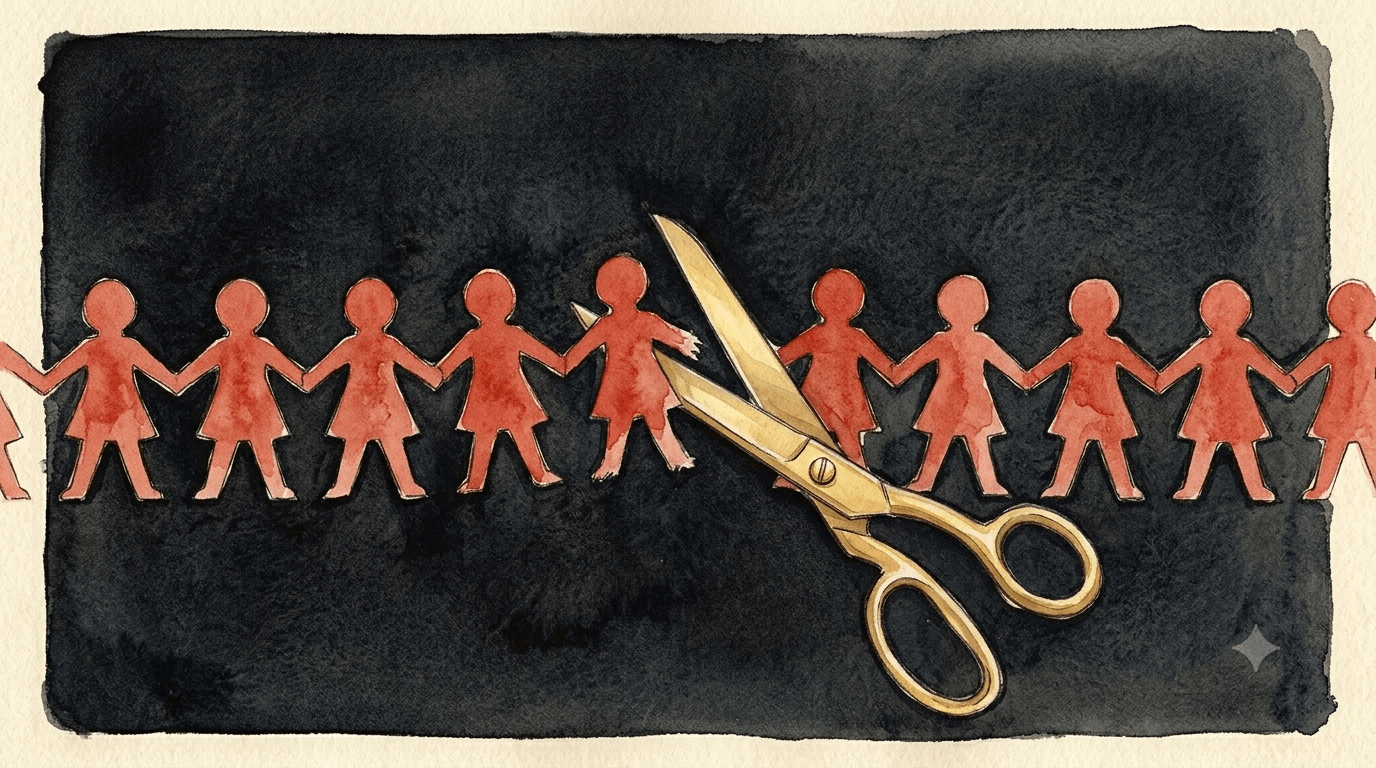
If the moral engine is privilege, there is a subtle seam that underpins it: a quiet dig at shallow altruism, anchored by the Hands Across America ad from the opening sequence and the little ways it shows up throughout (including the red jumpsuits). In reality, the 1986 event promised to raise tens of millions to fight domestic poverty and fell far short — the chain broke in places, most people held hands for free, and the hunger it was meant to fix outlived it. Peele lets that history do his work. Decades on, we are still governed by the same deep systemic inequalities, and the film seems to ask how much of our altruism is truly well-intentioned and how much of it is feel-good showboating.
It is in that final confrontation that Lupita Nyong’o gives an enrapturing, deeply nuanced performance as both Red and Addie — the two moving as one, a pas de deux that nods to the dance between bourgeoisie and proletariat. For those of us who noticed, there is a strong pay-off in the slow devolution of Addie’s demeanour. As the plot wears on, she descends into an almost maddened state — scratching, clawing, desperate to survive, and terrifying to watch. This is underscored by Jason’s (her son) reaction to her after she overpowers Red; for a second, he is unsure if she was truly his mother. It was all building up to this moment, and I suppose the film was telling us this all along — the fight for survival strips the tells, and with the tells stripped, we are all more alike than we are different.
As the film winds to a close, the final minutes deliver yet another astounding twist. It haunts me as I turn off the TV and prepare for bed. It would be too easy to land on the usual us versus them, or the haves versus the have-nots. Most of us know the difference between poverty, modest means, and wealth. Yet there is a vast sea of in-betweens we may miss in the everyday. So my thoughts meander instead to how privilege shows up in camouflage — in the absence of worry, in the liberty of generosity, in the risk appetite won from multi-generational efforts towards financial security I did nothing to earn. I think of people with exactly my means today whose psychology is nothing like mine, because they came from far more, or from far less.
Undress these sophisticated tells and you will see we are the same. We went to the same schools, worked at the same places — and yet we could not be more different. But the only difference that ever mattered is where we happened to begin.
✨ The Finish
🕯️ What Stayed: “We’re Americans.”
💬 If you asked me: A brilliantly crafted allegorical socio-political commentary delivered in a chilling pas de deux between a revolting proletariat and the bourgeoisie.
🏷️ Vintage
Released: March 2019 | Watched: Spring 2026
📝 Footnotes:
Where to Find the Film: Us – Youtube
 The Big Smokey Apple